
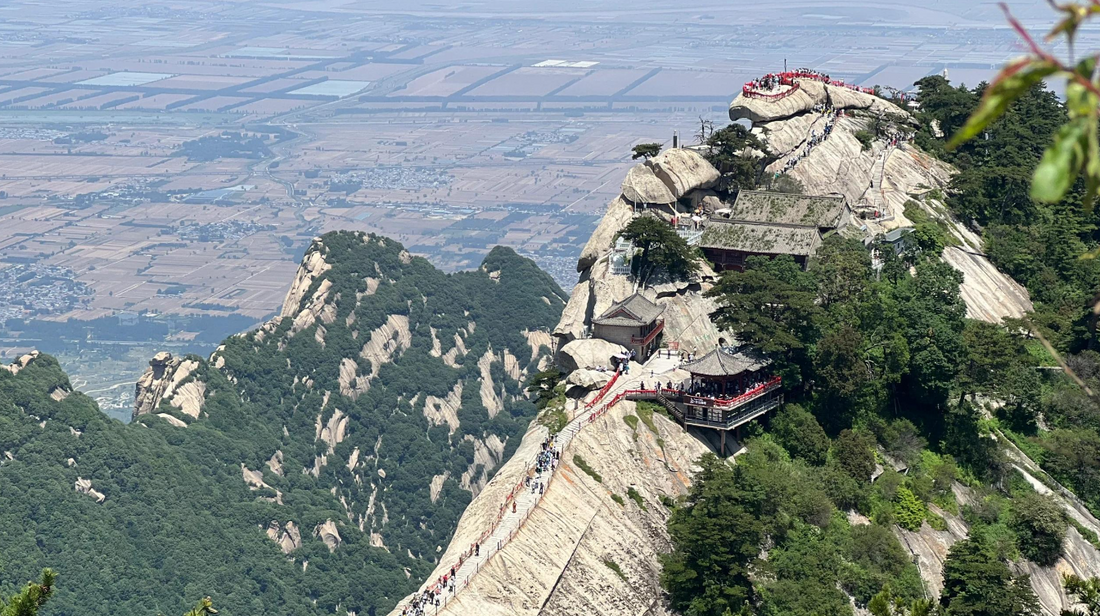
Huashan Mountain 华山
Paul PengHuashan Mountain, one of China's renowned Five Great Mountains, stands at an altitude of 2154.9 meters, ranking first among the Five Peaks. It is located in Huayin County, 120 kilometers east of Xi'an, Shaanxi Province. To the north lies the vast Weihe Plain and the roaring Yellow River; to the south, it leans against the Qinling Mountains, forming a granite peak on the northern side of the watershed ridge of the Qinling tributaries.

Huashan is not only a famous tourist destination but also a major site for Taoist activities. Legend has it that Laozi once visited here, and the "Laojun Plow Furrow" is said to have been personally carved by Laozi with a plow pulled by a green ox. To this day, Laozi's alchemy furnace remains preserved on the South Peak. Chinese Taoism is divided into two major sects, and Huashan Taoism belongs to the Quanzhen Sect, whose practitioners follow a vegetarian diet, live in monasteries, and remain unmarried. The prominent three characters "Quanzhen Cliff" carved on the rock wall of the Changkong Plank Road on the South Peak symbolize the sectarian affiliation of Huashan Taoism.
【Famous Taoist Attractions】
Yuquan Courtyard
Located at the trailhead on the northern foot of Huashan, Yuquan Courtyard is a garden-style Taoist monastery at the mountain's base. Nestled against the mountains, it is surrounded by ancient trees, where birds sing and winds whisper. Behind the courtyard, lofty peaks rise with rolling green clouds. It serves both as a scenic spot and a Taoist sacred site.

Founded by the renowned Taoist Chen Tuan during the Huangyou period of the Song Dynasty (1049-1054), the courtyard derives its name from a magical, sweet spring within its grounds. Its main structure is the Xiyi Shrine, whose central hall houses a statue of Chen Tuan.
Yuntai Temple
Approximately 1 kilometer north of Yuquan Courtyard lies Yuntai Temple, once a prominent center for Taoist activities. Records indicate it was inhabited by disciples of Laozi, and ancient emperors would visit here during their imperial tours to Huashan for heaven-worshipping rituals.

Officially established during the Wei, Jin, Southern, and Northern Dynasties, it flourished in the Song Dynasty but was destroyed in the Ming Dynasty. Yuntai Temple gained fame due to three notable figures who once resided here:
- Jiao Daoguang, a Taoist during the Wei, Jin, Southern, and Northern Dynasties;
- Chen Tuan, the Taoist patriarch of the early Song Dynasty;
- Gu Yanwu, a great Confucian scholar of the late Ming and early Qing Dynasties.
Xiyue Temple
Situated in Huayue Town at the foot of Huashan, Xiyue Temple is 7 kilometers south of Huashan and 2.7 kilometers west of Huayin County. The magnificent temple, shaded by towering ancient cypresses and enclosed by walls, served as the venue where feudal emperors of successive dynasties paid homage to Mount Hua.
First built during the reign of Emperor Wu of the Han Dynasty, it evolved into Huashan's largest temple after repeated renovations and expansions. Its main hall, Haoling Hall, enshrines the God of Huashan.
Maonv Cave
Maonv Cave, short for "Lower Courtyard of Maonv Cave," is located at the foot of Maonv Peak, named after the legendary Maonv. Liu Xiang of the Han Dynasty once eulogized her: "The graceful Jade Ginger fled with the times. A true immortal taught her prescriptions; she dined on pine needles and rare fruits. Through tribulation, she attained longevity and auspiciousness, finding joy in cliffs and caves, to the music of the qin and se."
In the early Song Dynasty, after taking refuge in Huashan, Chen Tuan wrote "Ode to Maonv" depicting her demeanor: "She once broke pine branches as sacred wands, wove chestnut leaves into silk robes. When asked about Qin Palace affairs, she smiled, twisting fairy flowers to gaze at the void." Over time, legends of Maonv grew more fantastical, making the cave widely renowned.

Qianchi Zhuang (Thousand-Foot Gorge)
Above Huixin Stone (Retreat Stone) lies Qianchi Zhuang, Huashan's first perilous stretch. Its vertical cliffs allow only two people to pass abreast, with a 70-degree slope and over 370 narrow steps. Climbers gazing upward see a "thread of sky"; descending feels like peering into a deep well, requiring glimpses of the path from beneath one's legs.
At the gorge's top is a cave barely fitting one person, called "Tianjing" (Heavenly Well) – climbers emerge through it onto a platform inscribed with "Taihua Throat," vividly describing the path as narrow, protruding, and lengthy. Blocking this point would cut off all passage.

Baichi Xia (Hundred-Foot Gorge)
Turning north from Qianchi Zhuang leads to Baichi Xia, the second dangerous section. Also called "Hundred-Zhang Cliff," it features towering rocks piercing the clouds. Its walls nearly meet but are propped apart by two boulders – "Jingxin Stone" (Startling Heart Stone) – under which travelers pass, fearing the stones might fall.
Laojun Li Gou (Laozi's Plow Furrow)
Ascending from Qunxian Guan (Immortals' View) brings one to this cliffside gully, its depths unseen, with stone steps clinging to the edge. Legend claims no path existed here until Laozi carved it with an iron plow pulled by a green ox, resembling a farmer's furrow.

North Peak
Descending Juxian Tai (Immortals' Gathering Platform) and crossing Hengcui Cliff reveals Yuntai Peak, 1500 meters above sea level. Named North Peak for its northeastern location, its rugged terrain, three sheer sides, and cloud-like appearance also earn it the name "Cloud Terrace Peak."
Changkong Zhandao (Skywalk Plank Road)
West of Sheng Biao Tai (Altar of Offerings), beyond Shimen Lou (Stone Gate Tower), lies Huashan's most dangerous spot. Carved into the South Peak's waist, it features sheer cliffs, horizontal iron chains, and narrow stone-slab paths anchored by stone piles below.
A local saying warns: "Beware, nine li and three fen – seek remains in Luonan and Shangzhou." Not a mandatory route, its walls bear warnings like "悬崖勒马" (Rein in at the cliff) and "云开溢荡" (Clouds part, waves surge).

Bizhao Ya (Edict-Evading Cliff)
Midway to South Peak is a cave fitting one person, inscribed with "Bizhao Ya" – said to be Chen Tuan's handiwork, where he hid from Emperor Taizong of Song's summons.
☯
Discover Taoist Wisdom
Taoism is China's ancient and only indigenous religion, embodying the principles of "Following Nature's Way" and "Wu Wei" (effortless action). Its ultimate pursuit is achieving immortality through spiritual enlightenment! Exploring Taoist wisdom can bring balance and serenity to modern life, and may even transform your destiny!
Explore Taoism
Part of the Series
This article is part of our comprehensive guide covering all core Taoist philosophies, concepts, and practices — curated from the classic Encyclopedia of Taoism.
View Full Guide → ✦ Explore All Topics


