
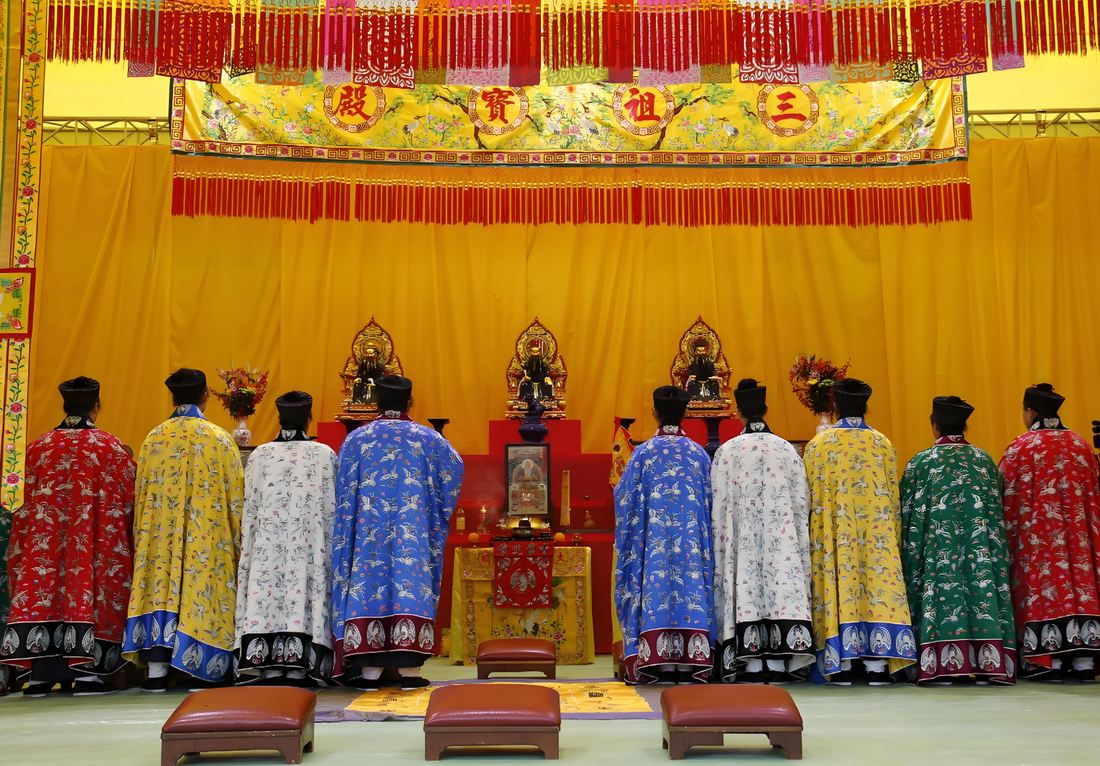
Taoist Scattering Flowers 道教散花
Paul PengScattering flowers is one of the common rituals in the composition of fasting and sacrificial ceremonies (zhaijiao). Lu Xiujing's Dongxuan Lingbao Zhai Shuo Guangzhu Jie Fa Deng Zhuanyuan Yi states that when celestial immortals descend to the ritual altar, "they all ride on flying clouds and green carriages, and eight-vision jade chariots. Accompanied by real persons and jade maidens holding flower banners in their hands, with phoenix songs leading the way in front and heavenly music following behind, white cranes and lions sing in harmony.
 They burn incense and scatter flowers, coming floating in the air." Therefore, scattering flowers was originally part of the imagined ritual procession of immortals' imperial carriages. Taoist rituals often transform into the sacrificial altar into a jade altar where immortals reside, and practitioners visualize themselves as immortals arriving at the altar to propagate the Tao. Thus, scattering flowers has become one of the ritual contents to praise immortals and transform the sacrificial altar.
The Art of Scattering Flowers: A Daoist Ritual
In the rich tapestry of Daoist traditions, the ritual of Scattering Flowers (散花, Sànhuā) holds a special place. This ceremonial act, rooted in ancient Chinese spirituality, is a poetic and symbolic gesture that bridges the earthly and divine realms. As described in Lu Xiujing’s Cave Mystery and Numinous Treasure Ritual, when celestial beings descend to the sacred altar, they arrive in a procession of ethereal splendor, accompanied by “flying clouds, jade chariots, and immortal maidens scattering flowers.” This vivid imagery paints a scene of divine grace, where flowers are offered as a tribute to honor the gods and sanctify the ritual space.
The Symbolism of Scattering Flowers
In Daoist ceremonies, scattering flowers is more than a decorative act—it symbolizes purity, devotion, and the ephemeral nature of existence. The flowers, often imagined as celestial blooms, are scattered to create a sacred atmosphere, transforming the altar into a heavenly realm. This ritual reflects the Daoist philosophy of harmony between humanity and the cosmos, where every gesture carries profound spiritual meaning.
The practice of scattering flowers is often part of the larger Jiao (醮) ceremonies, where the altar is envisioned as a celestial platform. Daoist priests, embodying the role of immortals, perform this ritual to invoke divine presence and blessings. The act is accompanied by chanting, incense, and music, creating a multisensory experience that elevates the soul and connects participants with the divine.
Cultural and Visual Elements
The ritual is steeped in visual splendor, with golden hues and yin-yang symbols often incorporated into the altar’s design. The yin-yang, representing balance and harmony, serves as a visual focal point, while golden borders evoke the opulence of celestial realms. These elements are not merely decorative but are imbued with spiritual significance, reflecting the Daoist pursuit of unity with the universe.
For those intrigued by Daoist culture, the scattering flowers ritual offers a glimpse into the profound beauty of Chinese spirituality. Whether you’re drawn to its philosophical depth or its aesthetic elegance, this practice invites us to pause, reflect, and connect with the divine through the simple yet profound act of offering flowers.
Part of the Series
This article is part of our comprehensive guide covering all core Taoist philosophies, concepts, and practices — curated from the classic Encyclopedia of Taoism.
View Full Guide → ✦ Explore All Topics


