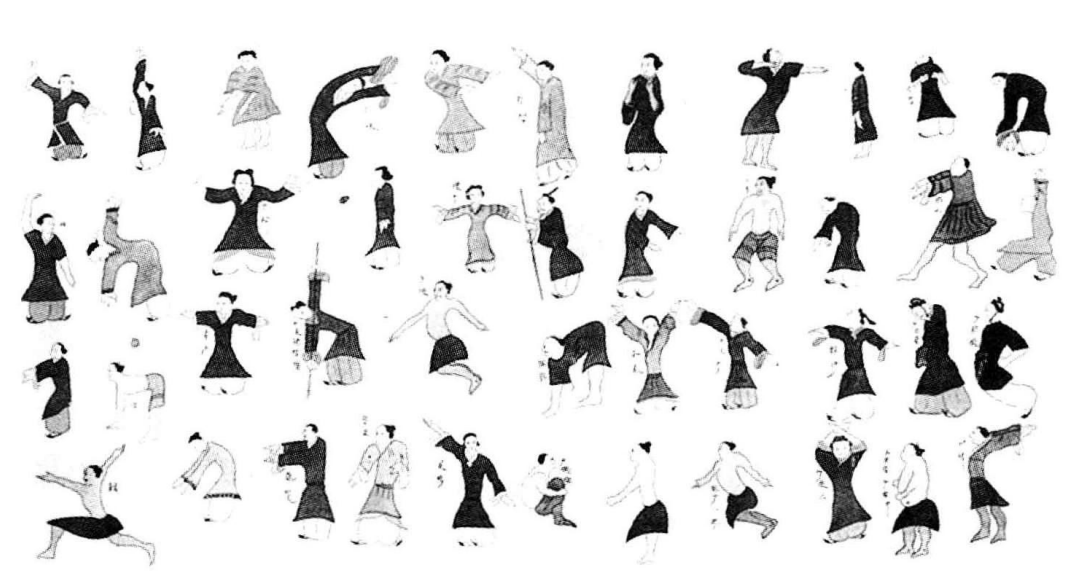
The so-called "Daoyin" refers to "guiding qi to make it harmonious, and stretching the body to make it supple". Its characteristic is to closely combine limb movements, breathing exercises, and self-massage under the guidance of ideas.
Daoyin technique originated in ancient times and was originally an ancient health-preserving method. As early as the Spring and Autumn and Warring States periods, it was very popular and valued by the immortals and doctors at that time. Later, Daoyin technique was inherited by Taoism and regarded as one of the methods for cultivation and health preservation, making it more precise and complete. It is believed that Daoyin has the effects of regulating nutrient and defensive qi, digesting food, eliminating pathogenic wind, benefiting qi and blood, curing various diseases, and even prolonging life.
In the 1970s, the silk painting unearthed from the Han tomb in Mawangdui, Changsha, is the earliest existing Daoyin atlas in the world. The original silk painting is about 100 cm long, connected with the 40 cm silk book in the front section. The painting is 40 cm wide. It is divided into 4 layers up and down, depicting 44 Daoyin patterns of various figures, with 11 paintings in each layer. Each pattern is 9 cm to 12 cm high on average. Each pattern is a portrait, including men, women, the elderly, and children, some wearing clothes, some with bare backs, all painted with meticulous brushwork and colorful colors. Except for a few portraits doing instrumental exercise,most of the patterns are free-hand exercises. There are names of techniques beside the pictures, and some words can be identified. Among them, there are eight styles involving animals: bird, harrier, crane, zhan (a kind of bird of prey), ape, monkey, dragon, and bear.
Hua Tuo in the Three Kingdoms period summarized the Daoyin techniques into five methods, named "Wuqinxi" (Five-Animal Games), namely tiger play, deer play, bear play, ape play, and bird play. It comprehensively summarizes the characteristics of Daoyin therapy, is simple and easy to practice, and has promoted medical treatment and health care in later generations.
Daoyin can be practiced according to the diagrams, including standing, sitting, and lying postures. The gentle exercise methods from the Sui and Tang dynasties to modern times, such as Baduanjin (Eight-Section Brocade), Baguaquan (Eight Trigrams Boxing), Yijinjing (Muscle-Tendon Changing Classic), Taijiquan (Tai Chi Chuan), Slow Walking Hundred-Step Method, Dachengquan (Great Achievement Boxing), and Wudang Sword, are all Taoist Daoyin health-preserving methods. In particular, Taijiquan has pushed traditional Daoyin to a new height. These exercise methods have the common characteristic of gentle and natural movements, which can maximize the activity of muscles, bones, and joints without easily causing damage; they can promote smooth and gentle blood circulation, enable tissues and organs to absorb a lot of oxygen, without making the heart beat violently, blood pressure rise suddenly, or metabolism accelerate suddenly. Therefore, Daoyin is a good health-preserving method suitable for both the old and the young. As long as you move your limbs and joints gently according to certain methods to make the qi and blood flow smoothly throughout the body, you can achieve the effect of health preservation and health care.
☯
Discover Taoist Wisdom
Taoism is China's ancient and only indigenous religion, embodying the principles of "Following Nature's Way" and "Wu Wei" (effortless action). Its ultimate pursuit is achieving immortality through spiritual enlightenment! Exploring Taoist wisdom can bring balance and serenity to modern life, and may even transform your destiny!
This article is part of our comprehensive guide covering all core Taoist philosophies, concepts, and practices — curated from the classic Encyclopedia of Taoism.
Paul Peng is a Zhengyi Taoist priest from Longhu Mountain, Jiangxi — the ancestral home of the Celestial Masters' tradition. Ordained at 25 after a dream from the Celestial Master, he has practiced for 25 years under Master Zeng Guangliang. He is one of the curators of this store, which is officially authorized by Tianshi Fu. All items are consecrated at the temple by the resident priest team.