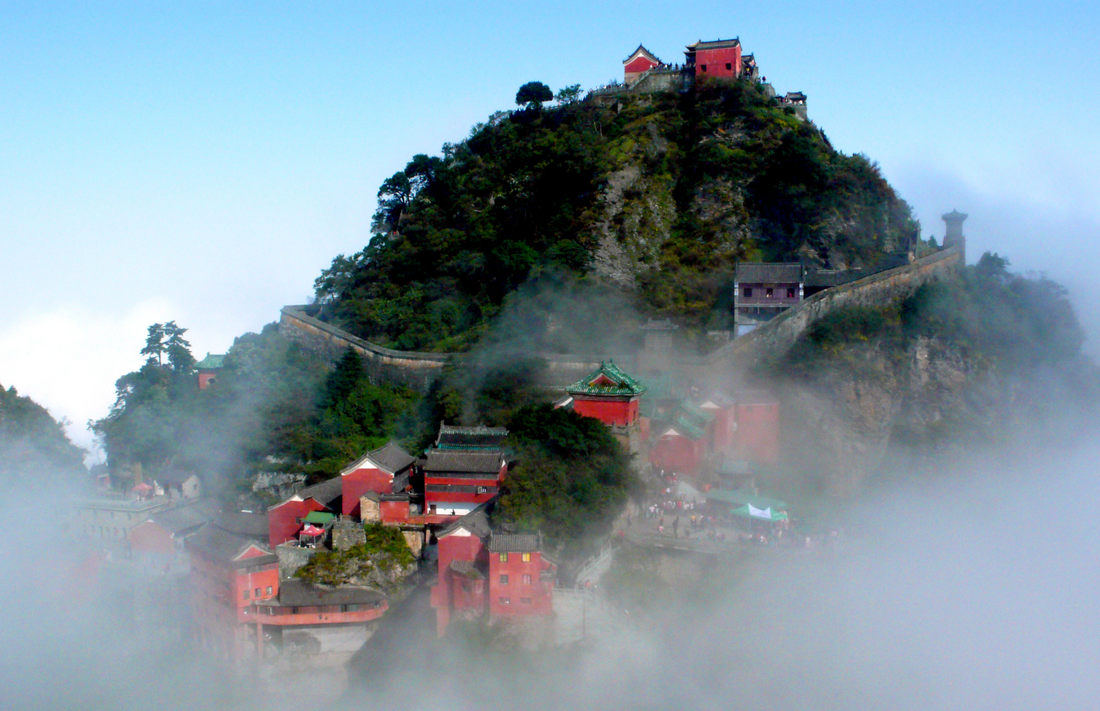
Wudang Mountain, located in Danjiangkou City, Hubei Province, is one of China’s renowned Taoist sacred sites, a UNESCO World Heritage Site, a national key scenic area, and the birthplace of Wudang Kung Fu. It is bordered by the historical city of Xiangfan to the east, the automobile city of Shiyan to the west, the primeval forest of Shennongjia to the south, and the large artificial freshwater Danjiangkou Reservoir to the north.
Since the Han Dynasty, Wudang Mountain has been a major center of Taoist activities, holding a prominent position in Chinese Taoist history and exerting a profound influence on traditional Han culture. Legend has it that many revered Taoist masters and immortals practiced here, including Yin Xi (Spring and Autumn Period), Ma Mingsheng and Yin Changsheng (Han Dynasty), Xie Yun (Jin Dynasty), Lü Dongbin (Tang Dynasty), Chen Tuan (early Song Dynasty), and Zhang Sanfeng (Ming Dynasty). The characters "Fu" (blessing) and "Shou" (longevity) on the walls of the Huangjing Hall in Nanyan were written in Chen Tuan’s own hand.
Wudang Mountain boasts not only stunning natural landscapes but also rich cultural attractions. Its unparalleled beauty is a harmonious blend of natural and humanistic splendor, earning it the reputation of "the unparalleled scenic spot since ancient times, the first fairy mountain under heaven."
【Famous Taoist Attractions】
Fuzhen Guan (Return to Truth Temple)
Fuzhen Guan is perched on Lion Peak of Wudang Mountain, with Tianchi Waterfall to its right and the 18-Bend Plank Road to its left. From a distance, it resembles a lotus emerging from water; up close, it looks like a magnificent fortified city. Also known as "Prince Slope," it was commissioned by Emperor Chengzu of the Ming Dynasty in 1412 to build the Xuandi Hall, mountain gates, and verandas.
Ancient architects ingeniously adapted to the mountain’s terrain, creating the "Nine-Bend Yellow River Wall"—a winding corridor following the slope’s contours, resembling the meandering Yellow River. Beyond the second gate lies a spacious courtyard, with layered, serene courtyards unfolding. Up front is the "Wuyun Tower" built into the rock, in the middle are the "Huangjing Hall" and "Scripture Repository," and at the rear is the "Prince Hall" atop a high platform. The layout, with staggered heights and balanced asymmetry, perfectly embodies the Taoist philosophy of "tranquility and non-action."
From the temple’s highest point, one can overlook deep valleys with crystal-clear streams, panoramic views of peaks vying for beauty, and the spectacular "Taihe Silhouette" at sunset. This ancient complex, built on a 60-degree slope of Lion Peak, is hailed by modern architects as a masterpiece of adapting buildings to steep terrain.
Yuxu Palace
Yuxu Palace, fully named "Xuantian Yuxu Palace," derives its name from the legend that Emperor Zhenwu (the Taoist god of water and warfare) was titled "Yuxu Prime Minister" by the Jade Emperor after achieving immortality. Commissioned in 1413 during the Yongle era of the Ming Dynasty and expanded during the Jiajing era (1522–1566), it was praised as a sacred place "where immortals from the Three Terraces and Ten Continents gather to salvation all beings under heaven." The renowned Ming literatus Wang Shizhen marveled, "Yuxu Palace rivals the grandeur of Qin Shi Huang’s Epang Palace."
Yuxu Palace once governed the entire Wudang Mountain. Uniquely among Taoist sites in China, it was permitted by the Ming emperor to maintain 500 Taoist soldiers for security—a rare privilege reflecting Wudang’s imperial status. Its massive, thick and heavy walls resemble a moon encircling a fairy palace; the three-arched gate, supported by intricately carved jasper Sumeru stone bases, and the glazed flower patterns on the flanking walls create a stunning contrast of red and green, exuding majesty and opulence.
Nanyan (South Cliff)
Nanyan, also called "Zixiao Cliff" (Purple Cloud Cliff) for its southern orientation, is revered in Taoism as the "sacred land" where Emperor Zhenwu attained immortality and ascended to heaven. Fully named "Great Sage Nanyan Palace," it perfectly merges Wudang’s natural and cultural landscapes, standing as the most scenic among Wudang’s 36 cliffs. Rebuilt in 1413 during the Yongle era, it retains structures such as the Stone Hall, South Heaven Gate, stele pavilions, and Liangyi Hall.
Legend has it that Lü Dongbin, one of the Eight Immortals, practiced here during the Tang Dynasty, leaving behind a poem. Nanyan’s unique attractions include Feisheng Cliff (a towering peak), the Dragon-Head Incense (a stone incense burner extending over a cliff), and ancient stone halls built on precarious ledges. Architects skillfully integrated small, delicate structures into the rugged terrain, creating a dramatic, imposing complex that breaks from traditional symmetrical layouts to harmonize with nature.
Zixiao Palace
Zixiao Palace was first built during the Xuanhe era of the Song Dynasty (1119–1125). According to records, Emperor Huizong of the Song, a devout Taoist, dreamed of the "Fire God" and was advised by a Taoist to build a temple in the south to honor the Water God for protection. Thus, he commissioned "Zixiao Yuansheng Palace" on Wudang Mountain. It was destroyed by the Jin army at the end of the Song Dynasty but rebuilt on a grand scale under Emperor Kublai Khan of the Yuan Dynasty, becoming a "national prayer site."
Backed by Zhanqi Peak, facing Zhaobi, Santai, and Xianglu Peaks, with Leishen Cave to the right and Yujichi Pond and Baozhu Peak to the left, Zixiao Palace is nestled in a natural "dragon-chair" formation of mountains—earning it the title "Zixiao Blessed Land" by Emperor Chengzu of the Ming. Its grand layout, with solemn halls housing numerous Taoist deities, creates a mysterious celestial realm.
The Zixiao Hall, Wudang’s only double-eaved gable-and-hip wooden structure and one of the few Taoist buildings using large beam frameworks, stands on three terraces, enhancing its majestic aura. With a thousand-year history, Zixiao Palace embodies Taoist principles of harmony with nature.
Golden Hall
The Golden Hall, a symbol of Wudang Mountain and a testament to Wudang Taoism’s imperial-supported prosperity, is a national treasure. Perched atop Tianzhu Peak (1,612 meters above sea level), it was built in 1416 during the Yongle era—a copper-cast, gilded structure measuring 5.54 meters in height, 4.4 meters in length, and 3.15 meters in width, ranking among the world’s finest copper architectural wonders.
Crafted in Beijing, its components were shipped via water to ancient Junzhou (modern Danjiangkou) and carried by hand to Tianzhu Peak for assembly. Recent research reveals its two massive foundations are fossil-bearing stones, hundreds of millions of years old, transported from elsewhere. The double-eaved gable-and-hip structure, modeled after imperial architecture, used 60 kilograms of gold for gilding. Its roof corners, adorned with lifelike dragons, phoenixes, sea horses, and immortals, and its seamless copper joints (including columns, beams, tiles, windows, and thresholds) showcase extraordinary craftsmanship.
Untarnished by nearly 600 years of storms, lightning, and extreme temperatures, the Golden Hall remains brilliantly gilded—an awe-inspiring feat of ancient Chinese casting and a testament to the wisdom and technological prowess of ancient laborers.
Taihe Palace Main Hall
Taihe Palace, known as "Chaosheng Hall" in the Ming Dynasty and renamed during the Kangxi era of the Qing Dynasty, is also colloquially called the "Golden Summit." Commissioned in 1412 by Emperor Chengzu and completed in 1416, it was expanded during the Jiajing era. The complex is divided by a wall: "Taihe Palace" outside and "Zijin City" (or "Golden Hall") inside, though they were originally one.
The "Dayue Taihe Palace" hall features a wall-less pavilion with exquisitely painted beams, flanked by bell and drum towers. The bell in the bell tower, cast in 1415, echoes across mountains like thunder. The hall, a stone-and-brick structure with a glazed-tile roof and stone sumeru base,houses over a dozen statues, including gilded copper figures of Emperor Zhenwu and his attendants. Housing artifacts from both the Ming and Qing dynasties, it holds high research value for its historical and cultural significance.
Wulong Palace
Wulong Palace, nestled against Lingying Peak and connected to Wulong Peak, was historically called a "dwelling of immortals" and a "responsive sacred place." According toRecords of Taihe Mountain, during a severe drought in the Zhenguan era of the Tang Dynasty (627–649), Emperor Taizong sent Junzhou Governor Yao Jian to pray for rain here. Yao Jian encountered five scholars, self-proclaimed "Five Dragon Lords," who brought down heavy rain, ending the drought. Emperor Taizong then ordered the construction of Wulong Shrine, marking the start of large-scale building on Wudang Mountain.
Expanded in 1412 by Emperor Chengzu and renamed "Xingsheng Wulong Palace," it boasted 850 halls and rooms by the Jiajing era, praised as "clusters of strange pines surrounding the palace like a thousand lotus blossoms." Legend holds that renowned Taoists such as Yin Xi, Yin Gui, Ma Mingsheng, and Chen Tuan attained enlightenment here. Surrounding Taoist relics include Huayang Cliff, Yinxian Cliff, Lingying Cliff, Lingxu Cliff, Laomu Cliff, and Ziran Nunnery. Combining scenic beauty and historical significance, Wulong Palace bears witness to the development of Wudang Taoism.
☯
Discover Taoist Wisdom
Taoism is China's ancient and only indigenous religion, embodying the principles of "Following Nature's Way" and "Wu Wei" (effortless action). Its ultimate pursuit is achieving immortality through spiritual enlightenment! Exploring Taoist wisdom can bring balance and serenity to modern life, and may even transform your destiny!
This article is part of our comprehensive guide covering all core Taoist philosophies, concepts, and practices — curated from the classic Encyclopedia of Taoism.
Paul Peng is a Zhengyi Taoist priest from Longhu Mountain, Jiangxi — the ancestral home of the Celestial Masters' tradition. Ordained at 25 after a dream from the Celestial Master, he has practiced for 25 years under Master Zeng Guangliang. He is one of the curators of this store, which is officially authorized by Tianshi Fu. All items are consecrated at the temple by the resident priest team.