
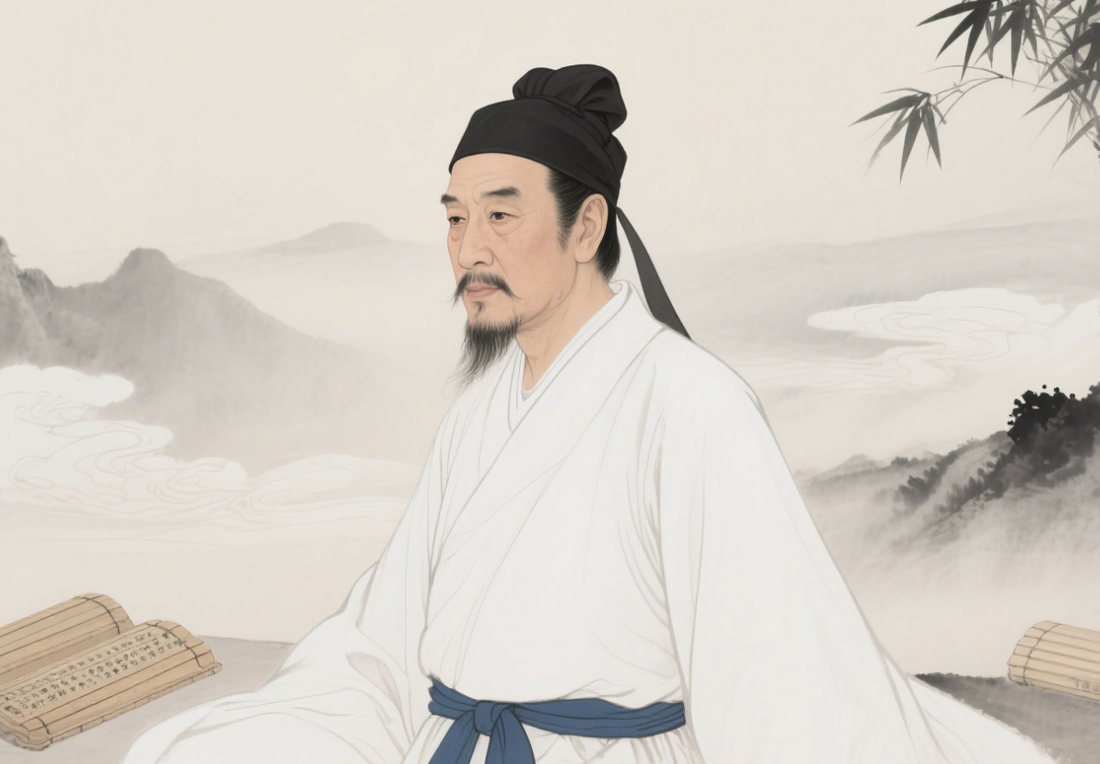
Daoist Figures:Zhang Zhan 张湛
Paul PengShare
Zhang Zhan
A philosopher of the Eastern Jin Dynasty and one of the representative figures of metaphysics. His courtesy name was Chudu, and he was from Gaoping (now northwest of Jinxiang, Shandong Province). He was mainly active around 373–396 CE.
He once held the positions of Gentleman of the Secretariat and Minister of Imperial Household. In terms of ontology, he advocated that "all existing things take the ultimate emptiness as their origin" (Preface to the Liezi). He divided the world into two realms: "all existing things" (qunyou) and "ultimate emptiness" (zhixu), believing that within the "realm of life" where "all existing things" reside, all things generate and transform themselves, ceaselessly in motion. He stated: "Yin and yang, the four seasons, and all changing things that belong to the realm of life are all governed by this transformative operation; the four seasons replace without pause, and all things transform without rest" (Annotation to Liezi·Tianrui*).

Beyond the "realm of life," he believed there exists an "ultimate realm" of ultimate emptiness, where there is neither birth nor death, and which is both empty and tranquil. He said: "When all things traverse the path of change, some are born while others die; but when we extend this to the ultimate realm, logically there is neither birth nor death" (ibid.).
He regarded ultimate emptiness and ultimate non-being as the cause and basis of the generation and transformation of all things, asserting that "ultimate non-being is therefore able to be the sovereign of all things" (ibid.).
He took ultimate emptiness and ultimate non-being as the highest ontology, further explaining the final destination of all things. He stated: "All things bear witness to their eventual extinction" (Preface to the Liezi*).
He failed to distinguish between the finite process of individual things (with a beginning and end) and the eternal, infinite development of the entire universe. He believed that the inevitable end of specific things meant the end of all things in the universe, which would then enter an eternal state of non-generation, non-transformation, non-birth, and non-extinction, returning to the ontology of "ultimate emptiness" and "ultimate non-being." He said: "All that is confined to a single form undergoes change and transformation with the passage of time; thus, what is born must perish, but that which gives birth to living things remains unchanging" (Annotation to Tianrui*).
He held that the dissipation of "all existing things" into non-being and their return to "ultimate emptiness" and "ultimate non-being" occur through the intermediary of "ji" (the subtle mechanism).
He explained: "That which remains unchanging amid the myriad forms and transformations, and which ultimately returns to the unchanging, is called 'ji.' 'Ji' is the origin of all existing things and the source of movement; thus, the emergence from non-being into being, and the dissipation from being back to non-being, all proceed through it" (ibid.). In philosophy, he synthesized the ideas of Wang Bi and Guo Xiang: he absorbed Wang Bi’s view that "non-being is the foundation of all things" and Guo Xiang’s idea that all things generate themselves, yet differed from both by emphasizing the temporality and transience of "all existing things" and regarding "ultimate emptiness" and "ultimate non-being" as the primary goals to pursue. He stated: "Divine wisdom remains perfect through tranquility and stillness; thoughts and desires lead to self-loss through attachment to things; waking life and transformed dreams are of equal significance" (Preface to the Liezi*).
In epistemology, he advocated intuitionism and obscurantism of "wordlessness and ignorance," asserting that "wordlessness is the origin of all words; ignorance is the master of all knowledge" (Annotation to Zhongni*).
He denied the necessity of acquiring knowledge from the external world, believing that the principles of heaven and earth are entirely concentrated within human beings themselves. He said: "Contemplating all forms within oneself, there is not a single thing that is not fully present; why need one look up and observe, look down and examine, traverse the court and the wilderness, to be fully acquainted with what can be seen?" (ibid.).
In theory of human nature, he advocated following and indulging one’s nature, asserting that "only by letting nature take its course without cultivation, and indulging it without regulation, can life and nature be preserved, and the world be peaceful" (Annotation to Huangdi*).
From this, he promoted a hedonistic philosophy of life, emphasizing the brevity of life, advocating seizing the moment to enjoy pleasure, and extolling ease while detesting toil. He asserted: "Loving ease and detesting toil is the inherent nature of all things. Thus, the joys of life consist merely of rich flavors, fine clothing, beautiful colors, and pleasant sounds" (Annotation to Yang Zhu*). His works include Annotations on the Liezi*. He also wrote Essential Collection on Nourishing Life (10 volumes) and Secret Records of Prolonging Life (12 volumes), both of which are lost.

About the Author
Paul Peng
Paul Peng is a Zhengyi Taoist priest from Longhu Mountain, Jiangxi — the ancestral home of the Celestial Masters' tradition. Ordained at 25 after a dream from the Celestial Master, he has practiced for 25 years under Master Zeng Guangliang. He is one of the curators of this store, which is officially authorized by Tianshi Fu. All items are consecrated at the temple by the resident priest team.
Read his full story →


