
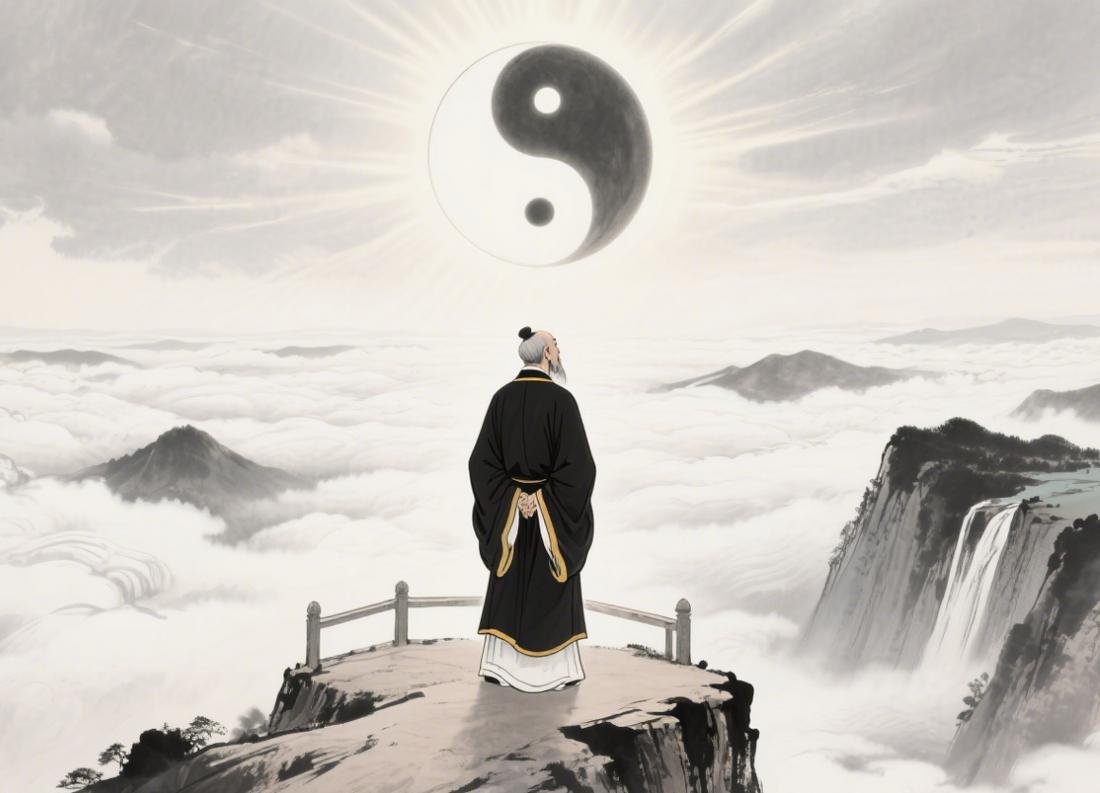
Huangfu Tan (皇甫坦) - The Taoist Master
Paul PengShare

Understanding the Taoist Priest (道士)
As one who has walked the mountain paths and meditated in temple halls for decades, let me share what it truly means to be a daoshi - a servant of the Tao.
The term 道士 literally means "scholar of the Way" or "gentleman of the Tao." We are not merely priests in the Western sense, but guardians of an ancient wisdom that flows like water through the valleys of Chinese culture.
The Three Treasures of a Daoist
| Treasure | Chinese | Meaning | Practice |
|---|---|---|---|
| Compassion | 慈 (Cí) | Loving-kindness toward all beings | Healing arts, helping communities |
| Frugality | 俭 (Jiǎn) | Simplicity and moderation | Living with minimal possessions |
| Humility | 不敢为天下先 | Not daring to be first in the world | Leading by example, not force |
The Path of Cultivation
When the morning mist rises from the sacred peaks, we begin our daily practices. The life of a Taoist priest revolves around these essential elements:
Internal Alchemy (内丹 - Nèi Dān)
This is the heart of our practice - transforming the body, mind, and spirit through meditation, breathing techniques, and energy cultivation. Unlike external alchemy that seeks the elixir of immortality through herbs and minerals, we create the golden elixir within ourselves.
External Practices (外功 - Wài Gōng)
- Ritual ceremonies for the community
- Feng shui consultations
- Traditional Chinese medicine
- Calligraphy and poetry
- Martial arts (particularly Tai Chi)
Historical Context: The Huangfu Lineage
The surname Huangfu (皇甫) carries significant weight in Chinese history. It's a compound surname that originated during the Spring and Autumn period, combining elements that suggest imperial favor and scholarly achievement.
Notable Historical Figures with Huangfu Surname
| Name | Period | Contribution |
|---|---|---|
| Huangfu Mi (皇甫謐) | 215-282 CE | Medical scholar, author of Zhenjiu Jiayijing |
| Huangfu Shi (皇甫湜) | Tang Dynasty | Literary figure and government official |
| Huangfu Song (皇甫嵩) | Han Dynasty | General who suppressed the Yellow Turban Rebellion |
The Three Schools of Taoism
Throughout our long history, Taoism has developed into distinct schools, each emphasizing different aspects of the Way:
Zhengyi (正一) - Orthodox Unity School
- Founded: Eastern Han Dynasty
- Focus: Ritual practices, exorcism, healing
- Priests: May marry and have families
- Centers: Mainly in southern China
Quanzhen (全真) - Complete Perfection School
- Founded: Jin Dynasty (12th century)
- Focus: Internal alchemy, celibacy, meditation
- Priests: Monastic lifestyle in temples
- Centers: Northern China, White Cloud Temple in Beijing
Shangqing (上清) - Supreme Clarity School
- Founded: 4th century CE
- Focus: Meditation, visualization, scripture study
- Legacy: Influenced later Taoist practices significantly
Daily Life in the Temple
The cock crows before dawn, and we rise with the natural rhythm of the cosmos. Our day unfolds like the petals of a lotus:
Pre-dawn (寅时 - Yín Shí, 3-5 AM)
- Morning ablutions and preparation
- Silent meditation facing east
Dawn (卯时 - Mǎo Shí, 5-7 AM)
- Morning prayers and incense offering
- Recitation of the Tao Te Ching
Morning (辰时 - Chén Shí, 7-9 AM)
- Community breakfast (simple vegetarian fare)
- Temple maintenance and gardening
Midday (午时 - Wǔ Shí, 11 AM-1 PM)
- Study of classical texts
- Calligraphy practice
Afternoon (未时 - Wèi Shí, 1-3 PM)
- Receiving visitors and consultations
- Preparation of herbal medicines
Evening (酉时 - Yǒu Shí, 5-7 PM)
- Evening prayers and reflection
- Group discussion of the Way
Sacred Texts and Wisdom
The foundation of our understanding rests upon these pillars of wisdom:
Primary Texts
- 道德经 (Tao Te Ching) - The fundamental text attributed to Laozi
- 庄子 (Zhuangzi) - Philosophical writings on naturalness and spontaneity
- 太平经 (Taiping Jing) - Classic of Great Peace
Daily Recitations
We often contemplate passages such as this from the Tao Te Ching:
"The sage does not attempt anything very big,
and thus achieves greatness."
"Water is fluid, soft, and yielding.
But water will wear away rock,
which cannot yield and is rigid."
The Art of Wu Wei (无为)
Perhaps no concept is more misunderstood by Western visitors than wu wei - often translated as "non-action." This is not laziness or passivity, but rather acting in accordance with the natural flow of events.
Think of a skilled boat captain navigating rapids. He doesn't fight the current but uses its power, making subtle adjustments with his rudder. This is wu wei - effortless action that achieves maximum effect with minimum force.
Practical Applications
- In governance: Leading by moral example rather than force
- In medicine: Supporting the body's natural healing processes
- In relationships: Responding appropriately rather than reactively
- In cultivation: Allowing spiritual development to unfold naturally
Modern Relevance
In these times of rapid change and technological advancement, the ancient wisdom of the Tao offers a refuge for the weary soul. Many Western seekers come to our mountain retreats seeking what their busy lives cannot provide: inner peace, connection with nature, and understanding of their place in the cosmic order.
The principles we've maintained for over two millennia - simplicity, harmony with nature, inner cultivation, and compassionate service - speak to universal human needs that transcend cultural boundaries.
Contemporary Applications
- Stress management through meditation and breathing practices
- Environmental consciousness rooted in Taoist harmony with nature
- Leadership philosophy based on humility and service
- Healthcare approaches emphasizing prevention and balance
Conclusion: The Endless Path
As Master Laozi taught us, "A journey of a thousand miles begins with a single step." Whether you are a scholar studying Chinese culture, a spiritual seeker exploring alternative paths, or simply someone curious about our traditions, remember that the Tao that can be spoken is not the eternal Tao.
The name Huangfu Tan represents not just an individual, but a lineage of seekers who have dedicated their lives to understanding the mysterious workings of the universe. In our simple robes and quiet contemplation, we carry forward a wisdom that has nourished the human spirit for countless generations.
May your path be clear, and may you find the stillness that reveals the movement of all things.
Part of the Series
This article is part of our comprehensive guide covering all core Taoist philosophies, concepts, and practices — curated from the classic Encyclopedia of Taoism.
View Full Guide → ✦ Explore All Topics
About the Author
Paul Peng
Paul Peng is a Zhengyi Taoist priest from Longhu Mountain, Jiangxi — the ancestral home of the Celestial Masters' tradition. Ordained at 25 after a dream from the Celestial Master, he has practiced for 25 years under Master Zeng Guangliang. He is one of the curators of this store, which is officially authorized by Tianshi Fu. All items are consecrated at the temple by the resident priest team.
Read his full story →


