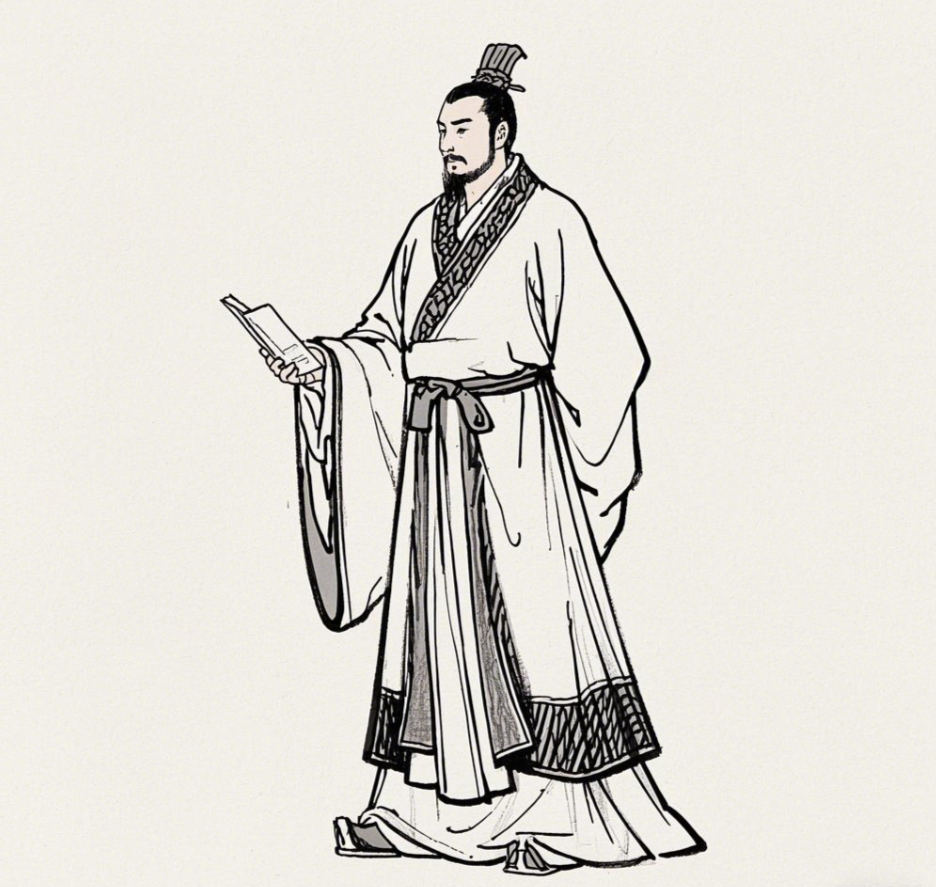
Cao Zhi (192~232) was a litterateur of the Wei State during the Three Kingdoms period. His courtesy name was Zijian. He was the third son of Cao Cao and the younger brother of Cao Pi. In the 16th year of the Jian'an era (211 AD), he was enfeoffed as the Marquis of Pingyuan, and in the 19th year (214 AD), he was transferred to be the Marquis of Linzi.
He was born in a time of chaos and grew up in the army. Later, he was squeezed and attacked by Cao Pi, repeatedly demoted, and moved his fiefdom several times within 11 years. He had great talents but no way to apply them, no opportunity to serve his country, often felt anxious and unhappy, and finally died of grief and indignation.
He was intelligent from an early age, with quick wit, and was good at writing. He made important contributions to poetry, fu (a literary form combining prose and poetry), and prose, and was highly regarded by writers in the Jin, Southern and Northern Dynasties. In literature, he advocated looking down to the people and drawing ideological nourishment from the folk. He said: "Street talks and alley discussions must have something to adopt; songs sung while beating the shaft of a cart are in line with the elegance ofThe Book of Songs; the thoughts of ordinary people should not be easily discarded" (Letter to Yang Dezu).
In terms of world outlook and outlook on life, he showed an obvious tendency towards Taoism. In his workExplanation of Sorrow, he pretended to be Mr. Xuanling and stated that people living in the real world only have pain and sorrow, while the Taoists' advocacy of inaction, emptiness, loneliness, nourishing the spirit and cherishing nature, as well as being free and unfettered, are precisely the good medicines to cure the illness of sorrow: "I will present you with the medicine of inaction, give you the soup of simplicity, treat you with the acupuncture of emptiness, apply the prescription of purity to you, settle you in a spacious house, seat you on a lonely bed, make Wang Qiao go with you, make Huang Gong sing with you as you walk, make Zhuangzi prepare the food for nourishing the spirit with you, make Laozi teach you the method of cherishing nature, let you seek a path to hide your traces, and ride on light clouds to soar."
In hisSeven Invitations, he pretended to be Wei Xuanzi and expressed his disdain for appearances and fame, as well as his admiration for Laozi and Zhuangzi: "At the beginning of the Taiji, chaos was not yet divided. All things were in confusion, coexisting with the Dao. For all that has form must decay, and all that has shape must come to an end. The vast primordial qi, who knows its end? Fame pollutes my body, and position burdens my person. I secretly admire the aspirations of the ancients and look up to the legacy of Laozi and Zhuangzi. I use the spiritual turtle as a metaphor, content to wag its tail in the mud."
In hisDiscourse on the Skull, he believed that the physical body and life are the greatest misfortunes, and death is the return to the original simplicity and the attainment of unprecedented happiness. He expressed his desire to return to the great void, taking eternal nothingness, stagnation, and depression as the ideal destination: "The Dao takes invisibility as its main aspect, so it can move with transformation. Yin and Yang cannot change it, and the four seasons cannot impair it. Therefore, it penetrates the realm of the tiny, reaches the courtyard of the vague and indistinct. Looking for it, you cannot see its form; listening for it, you cannot hear its sound. Scooping it, it is not full; pouring into it, it is not overflowing. Blowing on it, it does not wither; breathing on it, it does not flourish. Stirring it, it does not flow; condensing it, it does not stop. Being bound by the Dao, lying down in eternal sleep, there is no greater joy than this."
In terms of advocating Laozi and Zhuangzi and their tenets of emptiness and freedom, Cao Zhi's thoughts are consistent with the trend of metaphysics. There is a biography of him in Volume 19 ofRecords of the Three Kingdoms. His works includeCollected Works of Cao Zijian.
☯
Discover Taoist Wisdom
Taoism is China's ancient and only indigenous religion, embodying the principles of "Following Nature's Way" and "Wu Wei" (effortless action). Its ultimate pursuit is achieving immortality through spiritual enlightenment! Exploring Taoist wisdom can bring balance and serenity to modern life, and may even transform your destiny!
Paul Peng is a Zhengyi Taoist priest from Longhu Mountain, Jiangxi — the ancestral home of the Celestial Masters' tradition. Ordained at 25 after a dream from the Celestial Master, he has practiced for 25 years under Master Zeng Guangliang. He is one of the curators of this store, which is officially authorized by Tianshi Fu. All items are consecrated at the temple by the resident priest team.