
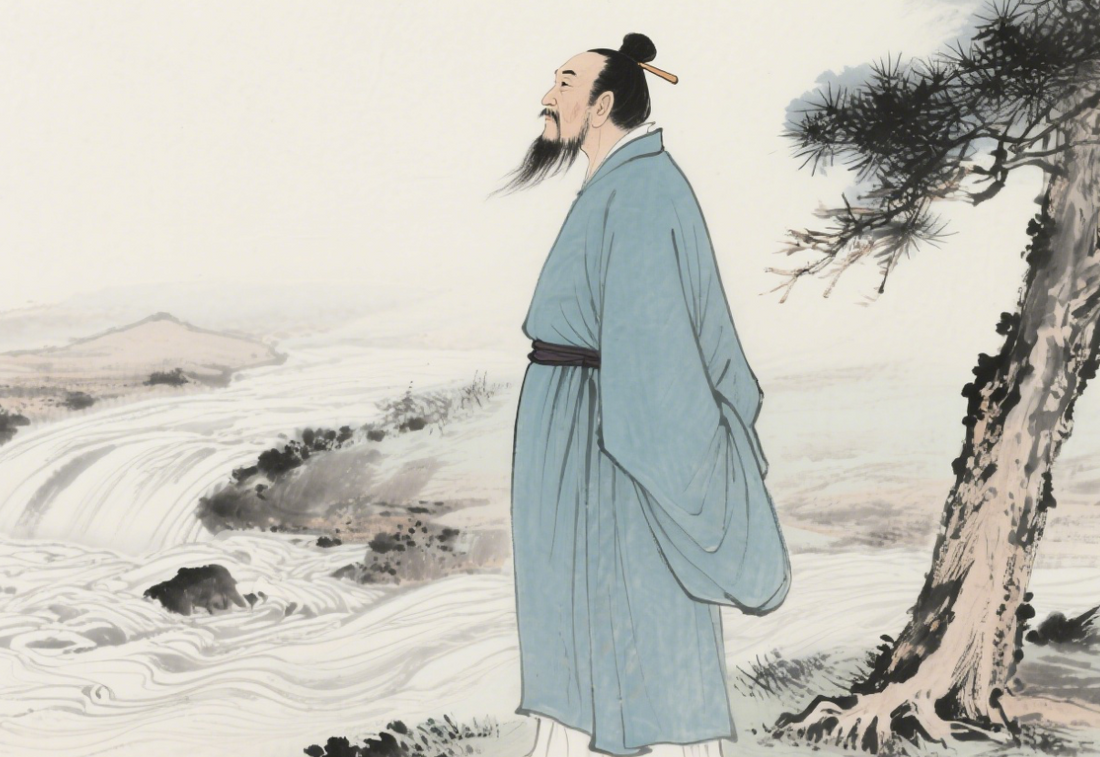
Who is Jiang You 江逌
Paul PengShare
Jiang You
(c. 305–362) A scholar and Taoist of the Western Jin Dynasty. His courtesy name was Daozai, and he was from Yu in Chenliu (now south of Qi County, Henan Province).
(c. 305–362) A scholar and Taoist of the Western Jin Dynasty. His courtesy name was Daozai, and he was from Yu in Chenliu (now south of Qi County, Henan Province).
Orphaned at a young age and living in poverty, he took refuge from chaos in seclusion, devoting himself to reading classics and books. Later, he held successive official positions, including Military Advisor to the General of the Northern Expedition, merit officer to the Cavalry General, magistrate of Taimo, court gentleman of the Secretariat, court gentleman of the Ministry of Personnel, and Grand Master of Ceremonies.

In philosophy, he leaned toward Taoism, advocating for "dwelling in seclusion and quietude, being ungoverned by external things," "not being obsessed with external objects," and "not abandoning tranquility and openness" (On Recluse Scholars, recorded in Anthology of Literary Works, Volume 36).
He adhered to the theory of "natural endowment" (xingfen) and used it to justify the rationality of the monarchical system. He stated: "The perfect man attends to affairs, governing and managing them, thus establishing hierarchy to rule over all living beings. Where does the monarch's position lie? It rests not only with the sage but also with the wise. The virtuous and the foolish support each other, and the relationship between ruler and subject is thus formed. Like the hundreds of joints in the body, each serves its natural form. Abiding by one's natural endowment and submitting to one's essence, all respond to a single harmony" (ibid.).
By emphasizing "abiding by one's natural endowment and submitting to one's essence," he meant that everyone should stay within their own natural bounds. All people, whether virtuous or foolish, ruler or subject, each have their own natural endowment and "serve their natural form," acting within their respective bounds without infringing on others. In this way, "the virtuous and the foolish support each other, and the relationship between ruler and subject is formed."
Starting from the theory of natural endowment, he emphasized that each should be content with their position. He said: "The heart and spine have their positions, the thighs and arms have their principles. Why should one feel sorrow or pride because of being in a lower position? Each is content with their place, and the whole body functions harmoniously" (ibid.). He believed that just as the heart, spine (lü), thighs (gu), and arms (gong) all have their own positions—none feeling troubled or honored by being in a higher or lower place, all being content with their roles—the same applies to people in society. When the organs of the human body are each content with their positions, "the whole body functions harmoniously"; similarly, when people in society are each content with their places, a harmonious order emerges. This is the principle Jiang You intended to explain regarding governing hierarchy "to rule over all living beings."
His biography is recorded in Volume 83 of The Book of Jin. He originally had a collected works in 9 volumes, which is now lost. Some of his works are compiled in Volume 107 of Complete Prose of the Jin Dynasty.

About the Author
Paul Peng
Paul Peng is a Zhengyi Taoist priest from Longhu Mountain, Jiangxi — the ancestral home of the Celestial Masters' tradition. Ordained at 25 after a dream from the Celestial Master, he has practiced for 25 years under Master Zeng Guangliang. He is one of the curators of this store, which is officially authorized by Tianshi Fu. All items are consecrated at the temple by the resident priest team.
Read his full story →


