
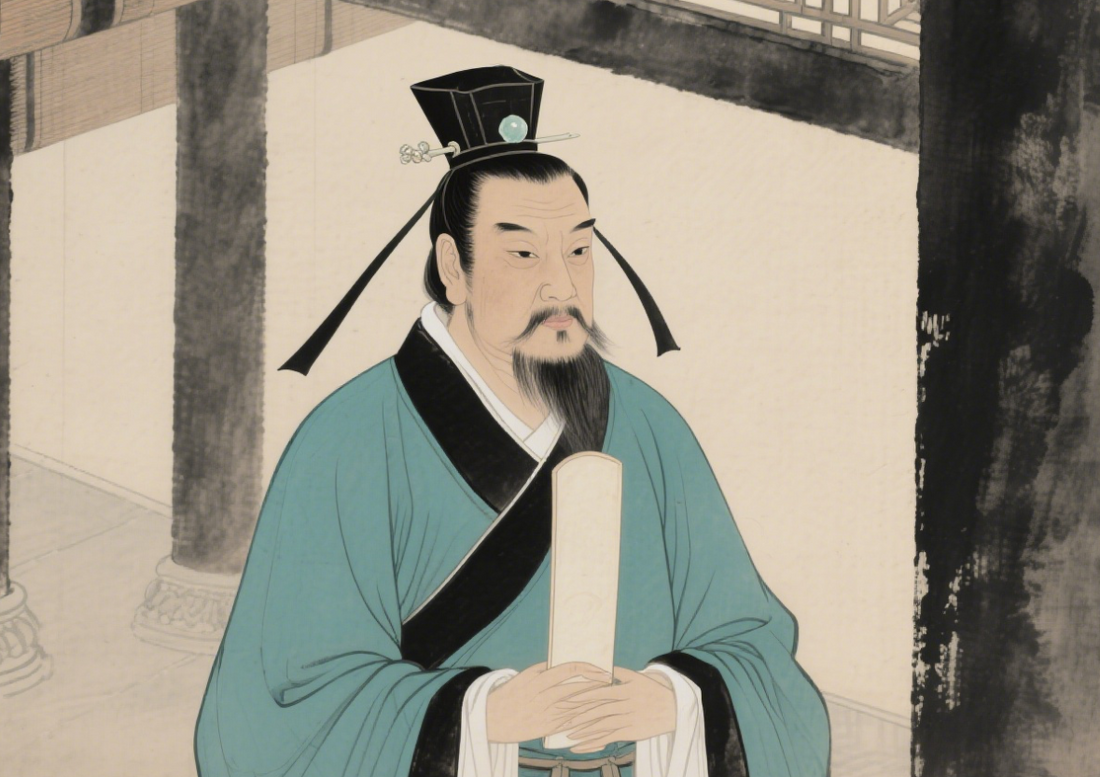
Who is Xia Houxuan 夏侯玄
Paul PengShare
Xia Houxuan,(209–254) A metaphysician of the Wei State during the Three Kingdoms period. His courtesy name was Taichu, and he was from Qiao in the Pei Kingdom (present-day Bozhou County, Anhui Province). He became famous at a young age and, at 20, served as a Sanqi Huangmen Shilang (Gentleman of the Yellow Gate and Cavalier Inquisitor). During the reign of Emperor Ming of Wei, he held the position of Yulin Jian (Overseer of the Feathered Forest Guards). During the reign of Cao Fang, the Prince of Qi of Wei, he served as Sanqi Changshi (Regular Cavalier Inquisitor), Zhonghu Jun (Central Protector of the Army), Zhengxi Jiangjun (General Conquering the West), and was granted Jiajie (the authority to act independently with a ceremonial staff) to supervise military affairs in Yong and Liang provinces.

After Cao Shuang was executed, he took office as Dahonglu (Minister of State Ceremonies) and Taichang (Minister of Rituals). He was killed along with his entire clan (three generations) after a plot with Zhongshu Ling (Head of the Palace Secretariat) Li Feng and Guanglu Daifu (Senior Counselor of the Imperial Household) Zhang Ji to assassinate Sima Shi was exposed. Yuan Hong, in his Biographies of Eminent Scholars, listed him alongside He Yan and Wang Bi as one of the "Eminent Scholars of the Zhengshi Period" (A New Account of the Tales of the World·Literature). He, together with Ruan Ji and others, "all wrote Treatises on Dao and De" (cited in the annotation to the same chapter from Jin Zhugong Zan [Eulogies of the Dukes of Jin]).

In philosophy, he adhered to Laozi's idea that "the Dao follows nature," believing that the essence of the "Dao" is nature—meaning the "Dao" has no will or purpose and is not governed by supernatural forces. He stated: "Heaven and earth operate through nature; sages act through nature. Nature is the Dao" (cited in the annotation to Liezi·Zhongni). He upheld the metaphysical view that "non-being is the foundation," arguing that the "Dao" is not only natural but also nameless. He said: "The Dao is inherently nameless; thus, Laozi said it is reluctantly named. Confucius described Yao as 'vast, beyond naming,' yet later spoke of his 'lofty achievements'—this is reluctantly assigning a name, taking what is known in the world to describe him. How could something with a name then be said to be 'beyond naming'? Only because it is nameless can it be named by all the names in the world" (annotation to Liezi·Zhongni). He believed the "Dao" is nameless because it is the formless and imageless ontological basis of the universe, distinct from any concrete, form-bearing things, and thus cannot be addressed by the names of specific objects. Therefore, "the Dao is inherently nameless" indicates that the "Dao" is essentially "non-being"; precisely because it is "non-being," it can serve as the ontological basis of concrete things, and precisely because it is nameless, "it can be named by all the names in the world." These ideas align with the Wei-Jin metaphysical view that "non-being is the foundation," represented by He Yan and Wang Bi.

His biography is recorded in Volume 9 of Records of the Three Kingdoms. He originally had a collected works in 3 volumes, which is now lost. Some of his works are compiled in Volume 21 of Complete Prose of the Three Kingdoms.

About the Author
Paul Peng
Paul Peng is a Zhengyi Taoist priest from Longhu Mountain, Jiangxi — the ancestral home of the Celestial Masters' tradition. Ordained at 25 after a dream from the Celestial Master, he has practiced for 25 years under Master Zeng Guangliang. He is one of the curators of this store, which is officially authorized by Tianshi Fu. All items are consecrated at the temple by the resident priest team.
Read his full story →


