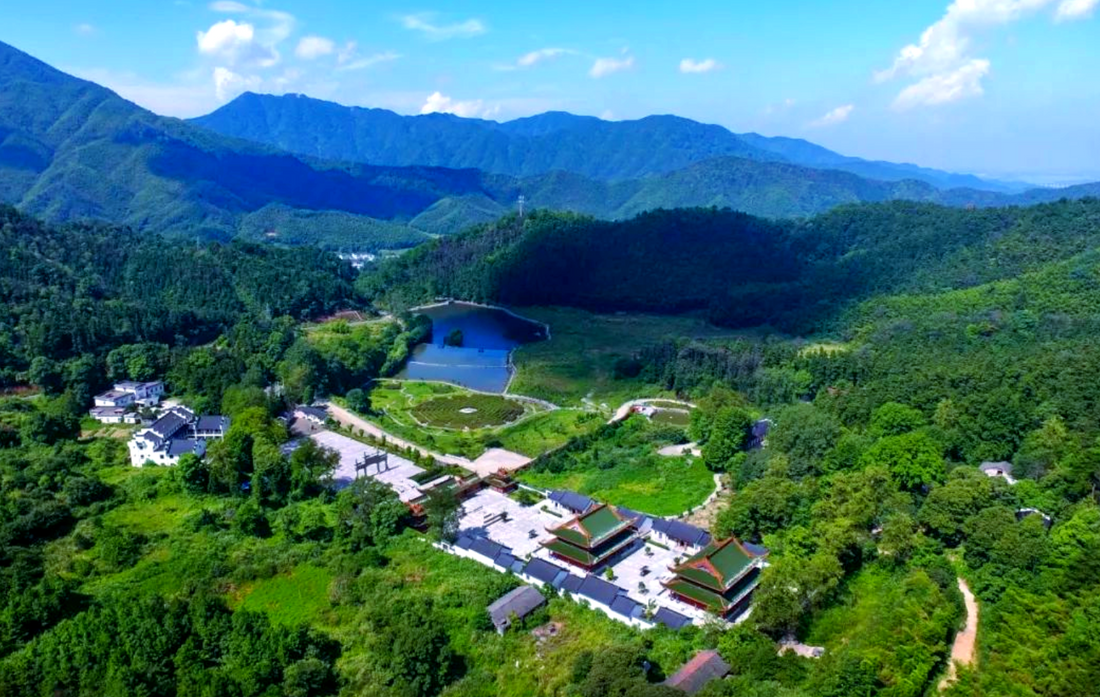
Le mont Gezao, situé dans le coin sud-est de la ville de Zhangshu, province du Jiangxi, est également connu sous le nom de "crête Ge". C'est une ramification de l'extension occidentale des monts Wuyi, s'étendant sur plus de 200 miles. Avec ses pics sinueux et ses crêtes superposées, ses bambous anciens et ses pins luxuriants, il est souvent enveloppé de nuages et de brume, d'où son nom de "Barrière verte de Qingjiang".
Le mont Gezao est une montagne célèbre intégrant la culture taoïste et l'histoire de la médecine traditionnelle chinoise. En la 7ème année de Jian'an de la dynastie des Han de l'Est (202), le célèbre taoïste Ge Xuan y atteignit l'illumination et pratiqua. Ge Xuan fut non seulement le fondateur de l'école taoïste Lingbao, mais aussi le fondateur de l'industrie pharmaceutique de Zhangshu, faisant du mont Gezao la montagne ancestrale du Zhangshu Medicine Gang. Après Ge Xuan, ses disciples continuèrent à prêcher, à affiner des élixirs, à cultiver des herbes médicinales et à pratiquer la médecine sur le mont Gezao, parmi lesquels Ge Hong apporta la plus grande contribution. Dans l'histoire du taoïsme chinois, les deux Ge sont collectivement connus sous le nom de "l'École taoïste Ge", et le mont Gezao devint ainsi un lieu sacré pour les taoïstes grâce à eux.
【Attractions taoïstes célèbres】
Grand Palais Wanshou Chongzhen
Ce palais est situé au pied sud du Pic Est dans la zone panoramique des Terres Bénies et est un site sacré taoïste. Composé de trois parties : les marches impériales, la porte du palais et la salle principale, il couvre une superficie de plus de 2 000 mètres carrés. Il s'agissait à l'origine du couvent Woyun construit lorsque Ge Xuan revint à la montagne en la 2ème année de Jiahe du Royaume de Wu (233). Sous la dynastie Sui, il fut appelé Lingxian Hall. Sous les dynasties Tang et Song, il reçut successivement les titres de "Vue de Gezao", "Vue de Ge Xuan Du", "Vue de Jingde", "Palais Chongzhen" et "Palais Wanshou Chongzhen" par décret impérial. En la 6ème année de Chunyou de la dynastie des Song du Sud (1246), l'Empereur Lizong lui accorda le titre de "Grand Palais Wanshou Chongzhen". Il existe de nombreux temples taoïstes préfixés par "Wanshou" (Longévité), mais ceux préfixés par "Grand Wanshou" sont extrêmement rares, ce qui témoigne de sa prospérité sous les dynasties Tang et Song.
Le palais existant a été reconstruit dans les profondeurs du mont Gezao, faisant face au pic Lingyun à l'avant et adossé aux montagnes Est et Ouest à l'arrière. La salle principale fait face au sud, avec plusieurs portes et des cours profondes, flanquées de longs corridors. C'est un bâtiment de structure mixte avec un toit en croupe et à pignon, des tuiles vernissées, des avant-toits volants à crête haute, des murs peints et des fenêtres à motifs. La salle abrite trois statues : l'Immortel Ge, le Maître Céleste Zhang et le Vrai Seigneur Xu, dont les apparences taoïstes solennelles inspirent le respect. Le palais connaît un flux constant d'encens et de visiteurs toute l'année.
Académie Ziyang
Cette académie est située sur la pente sud du Pic Est dans la zone panoramique des Terres Bénies, couvrant une superficie d'environ 860 mètres carrés. Sous la dynastie Song, c'était une salle dédiée à Taishang Laojun, Sakyamuni et Confucius, également connue sous le nom de "Palais Daode" (Palais de la Vertu). Elle fut appelée "Académie Ziyang" car Zhu Xi (également connu sous le nom de "Ziyang") y donna des conférences à plusieurs reprises. Elle fut détruite par un incendie de montagne sous la dynastie Ming. En la 8ème année de Yongzheng de la dynastie Qing (1730), Huang Yan, un local, finança la reconstruction de l'Académie Ziyang en une structure de briques et de béton.
L'académie est ombragée par des arbres anciens, dont un imposant ginkgo de près de 800 ans, des osmanthes dorés, des osmanthes argentés et des osmanthes des quatre saisons des dynasties Song et Yuan, ainsi que des plantes ornementales et médicinales rares telles que le podocarpus, le magnolia pourpre et l'arbre de Judée, la plupart ayant plus de 100 ans. De douces brises soufflent toute l'année, emportant un parfum persistant.
Jardin Baicao (Jardin des Cent Herbes)
Le jardin Baicao est situé au sud du pic Guabi dans la zone panoramique des Terres Bénies. On dit que l'Immortel Ge l'a fondé pour enseigner à ses disciples et fournir des soins médicaux d'urgence en collectant et cultivant diverses herbes des montagnes. Il fut nommé "Jardin Baicao" selon l'idée que "Shennong goûta cent herbes, et cent herbes forment mille prescriptions". Plus tard, grâce à la gestion des prêtres taoïstes du mont Gezao au fil des dynasties, surtout après que Fang Yizhi, l'un des Quatre Nobles de la fin de la dynastie Ming, y vécut en ermite et cultiva et traita des matériaux médicinaux, le jardin Baicao prit une plus grande ampleur.
Aujourd'hui, à l'intérieur de la porte de la grotte clôturée de bambous du jardin Baicao, des herbes médicinales célèbres produites dans les montagnes sont cultivées selon la disposition du diagramme des Huit Trigrammes, ce qui est assez distinctif. Avec des herbes médicinales parfumées et des fleurs exotiques en fleurs toute l'année, c'est un lieu intégrant tourisme et recherche scientifique.
☯
Découvrez la Sagesse Taoïste
Le taoïsme est l'ancienne et unique religion indigène de Chine, incarnant les principes de "Suivre la Voie de la Nature" et du "Wu Wei" (action sans effort). Sa quête ultime est d'atteindre l'immortalité par l'illumination spirituelle ! Explorer la sagesse taoïste peut apporter équilibre et sérénité à la vie moderne, et pourrait même transformer votre destin !
Cet article fait partie de notre guide complet couvrant toutes les philosophies, concepts et pratiques taoïstes fondamentales — tirées de la classique Encyclopédie du Taoïsme.
Paul Peng is a Zhengyi Taoist priest from Longhu Mountain, Jiangxi — the ancestral home of the Celestial Masters' tradition. Ordained at 25 after a dream from the Celestial Master, he has practiced for 25 years under Master Zeng Guangliang. He is one of the curators of this store, which is officially authorized by Tianshi Fu. All items are consecrated at the temple by the resident priest team.