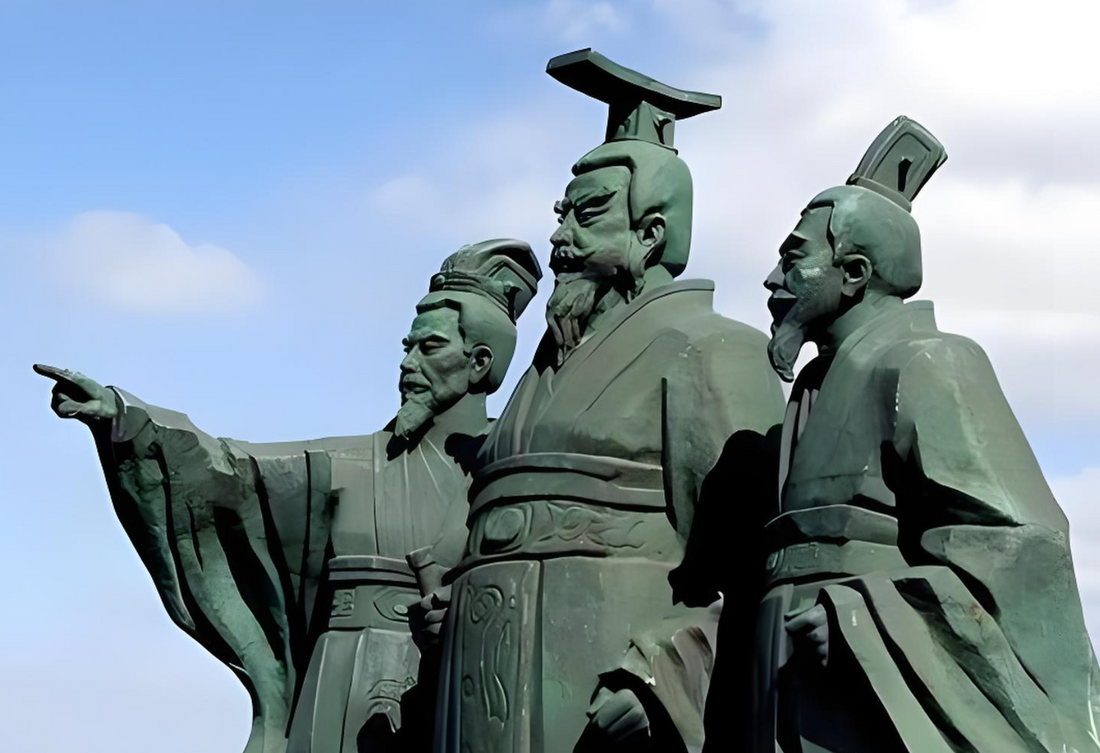
The Esoteric and Alchemical Thought in the Qin Dynasty
Paul Peng
Share
The alchemical and mystical thought that emerged after the Qin Dynasty unified the six states not only inherited traditional beliefs but also integrated various religious concepts, and even absorbed the more practically valuable spells from witchcraft and immortality practices. However, during this period, there still existed no traditional religion in the true sense of a religious order or church.
Such alchemical thought in the Qin Dynasty was extremely popular at that time and was widely accepted by the royal family, becoming part of court life. Emperor Qin Shi Huang was particularly fond of these mystical arts. After ascending to the throne, he repeatedly sent alchemists to seek immortals or divine medicines. For example, he dispatched Xu Fu, a native of Qi, to lead a group of boys and girls in search of the three sacred mountains—Penglai, Fangzhang, and Yingzhou—in the sea; he sent Lu Sheng, a native of Yan, to seek the immortals Xianmen and Gaoshi; and he ordered Han Zhong to look for the elixir of immortality.
Emperor Qin Shi Huang believed that coming into contact with immortals would enable him to become an immortal himself, and alchemists served as the medium between him and the immortals. Since Yingzhou was too distant and hard to find, he had to settle for the next best thing, hoping that the alchemists could find the elixir of immortality or refine a magic potion that would grant him eternal life through consumption. Ultimately, Emperor Qin Shi Huang failed to achieve his goal.
According toRecords of the Grand Historian: The Biography of Emperor Qin Shi Huang, at that time, Emperor Qin Shi Huang "summoned a great number of scholars and alchemists, hoping to bring about an era of peace, while the alchemists sought to refine miraculous medicines." However, "Han Zhong left and never returned; Xu Fu and others spent enormous amounts of money but never obtained the medicine, and daily reports of their fraudulent practices and greed emerged." Moreover, Lu Sheng, ungrateful for the emperor's great kindness, even began to slander him openly. This situation filled Emperor Qin Shi Huang with disappointment and anger, and to some extent, it led to the "burial of Confucian scholars."
This article is part of our comprehensive guide covering all core Taoist philosophies, concepts, and practices — curated from the classic Encyclopedia of Taoism.
Paul Peng is a Zhengyi Taoist priest from Longhu Mountain, Jiangxi — the ancestral home of the Celestial Masters' tradition. Ordained at 25 after a dream from the Celestial Master, he has practiced for 25 years under Master Zeng Guangliang. He is the curator of this store, which is officially authorized by Tianshi Fu. All items are consecrated at the temple by the resident priest team.